


The US military launched airstrikes targeting Iran’s paramilitary Revolutionary Guard to retaliate for the killing of American troops in Jordan, further widening the exchange of fire between them as an interim deal seeking an end to their war has collapsed.
The strikes on Sunday are part of a week-long campaign that began with a struggle over control of the Strait of Hormuz and has seen Iran strike US-allied countries across the Middle East.
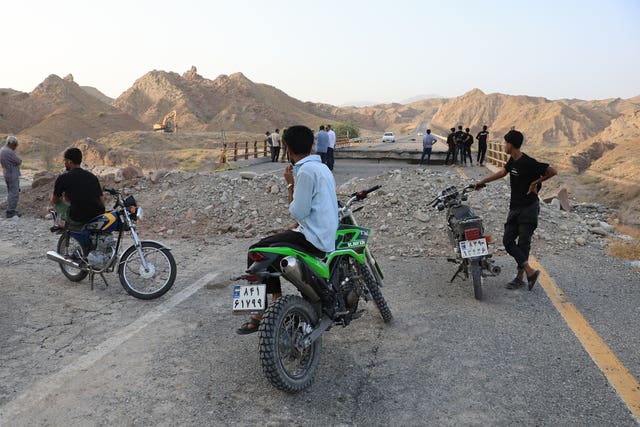
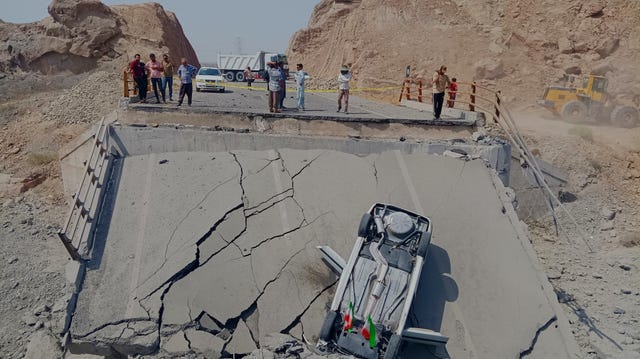
The US has targeted bridges, electrical facilities and other targets in Iran, and Tehran has retaliated by hitting power and desalination plants in Kuwait, threatening daily life in that small, oil-rich desert nation.
Iran also has stepped up its threats to further expand the strikes, drawing a warning overnight from the United Arab Emirates.
Kuwait and Bahrain again activated air defences on Sunday morning as they warned of incoming Iranian drones and missiles.
The US military’s Central Command in its statement also said it hit “Iranian military coastal surveillance and air defence facilities, maritime capabilities and missile and drone storage sites”.
It said the attack was designed to degrade Iran’s ability to control the Strait of Hormuz and “swiftly punish Islamic Revolutionary Guard Corps forces”, a key power base in Iran’s theocracy that controls its ballistic missile arsenal.
Footage released by the US military appeared to show strikes carried out by fighter jets and by Tomahawk cruise missiles launched from the sea.
One target site appeared to be in a valley of a mountainous region.
The Guard often has missile bases and other military equipment tucked into mountain ranges.
Iran has provided no overall information on its material losses in the American campaign, which is now in its eighth day as the nations vie over control of the Strait of Hormuz, the narrow mouth of the Persian Gulf through which a fifth of all oil and natural gas traded passes in peacetime.
Iran’s atomic energy agency said that US strikes early on Sunday morning targeted a construction site of a planned nuclear power plant in south-west Iran, according to Iranian state television.
Iran had not previously announced that the site of the Darkhovin Nuclear Power Plant, which it says does not yet generate power, had been struck during the war.
An Iranian attack on a base in Jordan killed two American service members, left one missing and four requiring hospital treatment, the US military said.
USS Donald Cook (DDG 75) transits the Arabian Sea while an MH-60S Sea Hawk flies nearby. American forces continue to strictly enforce the ongoing naval blockade against Iran. As of July 18, CENTCOM has redirected 5 commercial vessels and disabled 1. pic.twitter.com/HHmXIE0MgC
— U.S. Central Command (@CENTCOM) July 18, 2026
Since the war began, 16 US service members have been killed and more than 430 wounded.
Iranian authorities said on Saturday that at least 50 people have been killed and more than 500 wounded in the latest US strikes.
Kuwait said on Sunday that one of the country’s power and water desalination plants was attacked for the second time in two days, causing fires.
Its Ministry of Water and Renewable Energy said that the power grid remains stable, yet the attack marked the latest instance in which strikes — by both the US and Iran — have targeted civilian infrastructure used by millions of people.
In Kuwait, about 90% of drinking water comes from desalination.
The attacks in Kuwait and Bahrain were the latest reported by US regional allies, including Jordan and Persian Gulf monarchies.
Iran has over the past week refrained from striking Israel — which has stayed out of this round of fighting — or the United Arab Emirates, a regional military power.
The semi-official Iranian news agency Fars, believed to be close to the Guard, issued a threat against the UAE late on Saturday.
Quoting an anonymous official, Fars said that continued strikes on Iranian civilian infrastructure would mean that the “airports of Dubai and Abu Dhabi, as well as the ports of Fujairah and Jebel Ali, must be immediately evacuated”.
Apparently responding to the threat, the Emirates’ Foreign Ministry issued a statement calling “for exercising the utmost restraint in order to avoid dangerous repercussions and the region being pulled into new levels of violence and instability”.
During the Iran war, officials say both the UAE and Saudi Arabia carried out retaliatory airstrikes against Tehran for targeting their nations.
The secretary-general of the six-nation Gulf Cooperation Council, Jasem Mohamed al-Budaiwi, accused Iran of war crimes for strikes on infrastructure and civilian facilities.

Legal experts say attacks on infrastructure — power plants, bridges and desalination facilities — that is used to sustain civilian life can amount to war crimes.
If no steps are taken to avoid harming civilians, such is the case even if the sites serve military purposes.
US President Donald Trump has threatened to target Iran’s power stations and bridges to try to compel Tehran to loosen its hold on the Strait of Hormuz.
Recent attacks suggest the US military is carrying out that plan, beginning first with coastal areas of Iran on the strait.
The US in the past week also reimposed a naval blockade on Iranian ports to halt its shipments of crude oil, and the military on Saturday said it had redirected five ships and disabled one since then.
Iran’s Supreme Leader Mojtaba Khamenei, in a statement on Saturday, warned of “unforgettable lessons” if the US keeps attacking the Islamic Republic.
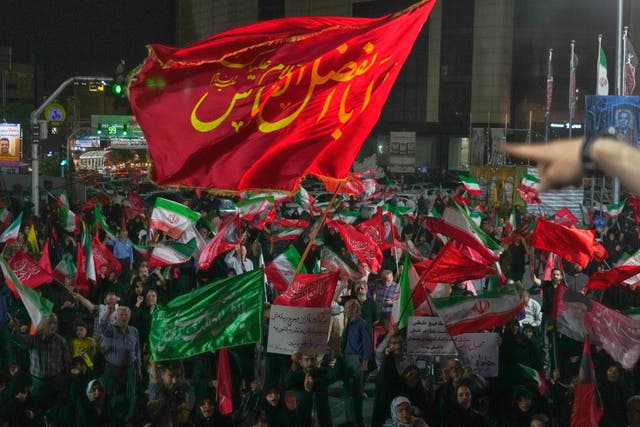
An Iranian negotiator said Tehran was suspending its commitments to the interim deal signed about a month ago and aimed at permanently ending the fighting.
Iran’s joint military command said that US “covetousness, bullying, totalitarianism or brutality” would meet with a “devastating response”.